World Cup History: Origins and Evolution
How the FIFA World Cup grew from a 13-team invitational in Uruguay in 1930 to the 48-team tournament of 2026, and the rules, formats and trophies that changed along the way.
The FIFA World Cup stands today as the world's most-watched sporting event, with billions of viewers tuning in every four years. But this global phenomenon had humble beginnings, shaped by the vision of determined individuals and the challenges of bringing nations together through sport.
The Birth of a Dream
The story of the World Cup begins with Jules Rimet, who served as FIFA president for 33 years from 1921 to 1954. Born in a small French village in 1873, Rimet believed that football could unite nations and promote peace in a world recovering from the devastation of World War I. Having fought through the First World War, Rimet believed that sport could channel nationalism in a more positive way.
While FIFA had been established in 1904, the idea of a world championship took decades to materialize. At the FIFA Congress held in Amsterdam on May 28, 1928, the federation officially decided to organize its own world football championships. This marked the official birth of what would become the World Cup.
Uruguay 1930: The Inaugural Tournament
Uruguay was selected to host the first World Cup, as the country would be celebrating the centenary of its first constitution and had won back-to-back Olympic gold medals in 1924 and 1928. The South American nation's football success and willingness to cover all costs, including travel expenses for participating teams, made them the ideal choice.
However, organizing the first tournament proved challenging. The Great Depression caused economic hardships worldwide, and very few players wanted to travel so far and for so long as they feared losing their regular income. By the February 1930 deadline, no European team had accepted the invitation. Rimet personally intervened, convincing France and Yugoslavia to participate, with Belgium and Romania eventually joining them.
The tournament took place from July 13 to 30, 1930, with thirteen teams participating: seven from South America, four from Europe, and two from North America. Notably, this was the only World Cup in history with no qualifying rounds; all teams were invited.
The first two matches were played simultaneously on July 13, with France defeating Mexico 4-1 and the United States beating Belgium 3-0. French striker Lucien Laurent scored the first goal in World Cup history in the 19th minute. The tournament culminated with Uruguay defeating Argentina 4-2 in the final before a crowd of 93,000, becoming the first world champions.
Early Growth and Challenges
The tournament's early years were marked by expansion and political complications. Since the second World Cup in 1934, qualifying tournaments have been held to thin the field for the final tournament. The format began to take shape, though participation remained inconsistent.
The 1950 World Cup in Brazil was the first to include British football associations, which had withdrawn from FIFA in 1920. Between 1934 and 1978, most tournaments featured 16 teams, though this varied due to withdrawals and political circumstances.
The Second World War forced the cancellation of the 1942 and 1946 tournaments, threatening the competition's future. However, Rimet's dedication ensured the World Cup's survival and eventual growth.
Format Evolution Through the Decades
The World Cup format has undergone several major transformations:
- 1930-1950: The early tournaments featured between 13 and 16 teams with varying formats. The 1930 edition used a unique group stage followed by semi-finals, with no third-place playoff.
- 1954-1978: The tournament standardized around 16 teams, with 26 to 38 matches played during this period.
- 1982-1994: In Spain's 1982 World Cup, 24 teams were able to qualify for the tournament, a format that lasted until 1994.
- 1998-2022: From France's 1998 World Cup to Qatar 2022, 32 teams competed in the tournament with 64 matches played in total each time. This era saw the establishment of eight groups of four teams, with the top two advancing to knockout rounds.
- 2026 onward: The 2026 World Cup, co-hosted by the United States, Mexico and Canada, was the first with 48 teams, 16 more than the previous seven tournaments. Teams were split into twelve groups of four, with the top two in each group and the eight best third-placed teams moving on to a new round of 32. That raised the number of matches from 64 to 104. Spain won it, beating defending champions Argentina 1-0 after extra time in the final on July 19, 2026, for their second world title.
The Qualification Process
The qualification system has evolved to accommodate the tournament's global reach. Qualifying tournaments are held within the six FIFA continental zones, with FIFA deciding the number of places awarded to each zone based on the relative strength of the confederations' teams. The qualification process can start almost three years before the final tournament and involves over 200 teams worldwide.
An important change came after 2002: The right to automatic qualification for defending champions was withdrawn from the 2006 FIFA World Cup onward, requiring champions to qualify like other nations. Brazil became the first defending champions to play qualifying matches.
Rules and Innovations
Beyond the basic format, the World Cup has seen numerous rule changes and innovations:
- Points System: Since 1994, FIFA has employed a straightforward points system where winners receive 3 points for a victory, compared to only 2 points before 1994. This change was implemented to encourage more attacking play and reduce defensive-minded draws.
- Third-Place Matches: While absent from the 1930 tournament, third-place playoffs became a regular feature starting in 1934, providing additional competitive matches. The one exception was 1950, when the tournament was decided by a final group of four instead of knockout games.
- Technology: Modern tournaments have embraced technological advances like VAR (Video Assistant Referee) and goal-line technology to ensure fair play and accurate decision-making.
The Trophy's Journey
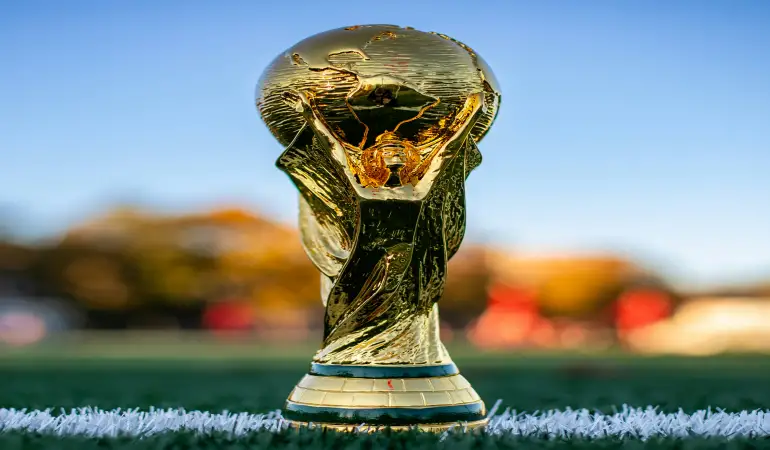
The original World Cup trophy, designed by French sculptor Abel Lafleur, became known as the Jules Rimet Trophy in 1946 to honor the tournament's founder. Brazil won the tournament for the third time at the 1970 World Cup and were awarded the trophy permanently. A new trophy was created for the 1974 tournament, which remains in use today.
A Global Phenomenon
From 13 invited teams in 1930 to 48 teams in 2026, the World Cup has grown enormously. What began as Rimet's vision of using football to promote peace and unity has evolved into an event that captivates nearly half the world's population every four years.
The tournament's evolution reflects football's global expansion, with increased representation from all continents and formats designed to balance competitive integrity with inclusivity. As the World Cup continues to adapt and grow, it remains true to its founding purpose: bringing the world together through the beautiful game.